
visibus Blog
What does AI cost a company? Flat rate, per head or by usage

by Fabian Schmid · July 7, 2026 · 5 min read
An AI flat rate sounds like predictability: a fixed amount per user, done, check the box. That's exactly what makes it attractive - and that's exactly where two mistakes hide that cost you money.
Mistake 1: You pay per license, not per use
As an add-on, Microsoft 365 Copilot costs around 30 US dollars per user per month, on top of the Microsoft 365 license. For 50 users, that's a good 1,300 francs a month. Every month. Regardless of whether all 50 ever touch the AI.
In practice, they don't. A few use it every day and intensively, many occasionally, a good chunk of the workforce not at all. With a flat rate, you pay for the non-users in full. You buy 50 licenses and pay for the half-empty seats.
To be fair: if everyone in your company really does work intensively with AI every day, a flat rate can pay off. But that's the exception, not the norm - and it's a calculation you should run, not assume.
Mistake 2: The flat rate is artificially cheap
This is the point that rarely makes it onto the table. Today's AI prices are subsidized.
In early 2025, OpenAI chief Sam Altman said publicly that the company is losing money even on its 200-dollar Pro plan: "We're currently losing money on the Pro subscriptions - people use them way more than we expected." Over the same period, OpenAI reportedly posted around five billion dollars in losses on just under four billion in revenue.
This isn't an accident, it's strategy: the big providers use investor capital to buy market share and sell their services below cost. On top of that comes an inconvenient quirk of AI - unlike classic software, every use gets additionally expensive, because it eats compute time. More usage means more cost, not less.
Together, that means: today's cheap flat rate is a snapshot, financed with other people's money. It's not a stable figure. The fact that Microsoft raised Microsoft 365 prices across the board as of July 1, 2026 - citing AI as the reason - is only the first visible step. Anyone building their AI strategy on today's flat-rate price is building on sand.
Why the price pressure will grow
So far, investor capital covers the difference - and the losses are growing, not shrinking. For 2025, the financial documents seen by the Wall Street Journal show around nine billion dollars in losses at OpenAI; for every dollar it took in, the company spent about 1.70 dollars. Even so, the big providers are valued close to the trillion-dollar mark - Anthropic officially at 965 billion dollars, OpenAI most recently at around 850 billion.
And both are heading for the stock market: in 2026, OpenAI and Anthropic each filed a confidential IPO request with the US Securities and Exchange Commission. Given the tense market conditions, the actual market debut will likely slip to 2027 - which doesn't change the direction. An IPO shifts the logic. As long as a company is private, growth is what counts, and losses are part of the plan. On the stock market, the bottom line eventually counts - and the biggest lever for turning red numbers black is price. According to the financial plans both have shown their investors, neither expects profits before the end of the decade: Anthropic is aiming for 2028, OpenAI not before 2030. Until then, someone has to close the gap. Increasingly, that will be the customers.
What really matters: what you can plan for
The takeaway isn't a reflexive "flat rate bad, usage-based good." It's a different question: which number can you actually plan with?
visibus Chat bills by actual usage - in one place, for the whole company. Whoever works a lot generates more cost; whoever doesn't need the tool costs nothing. No empty seats on the invoice. And you see real consumption instead of a flat license price: per user, per model, in real time, with a budget as the cap.
To stay honest: we buy the models from the same providers, too. When their prices normalize, that affects everyone. The difference is visibility - with usage-based billing, a price change shows up in the consumption you already watch, instead of as a silent markup on a license price you never question.
The right model instead of the most expensive one
There's a cost lever a flat rate doesn't have by definition: the right model for each task. Not every request needs the most expensive premium model - a short summary runs on a small, fast model for a fraction of the cost; the complex analysis can go to the big one. Anyone who has only one model - or reflexively always picks the biggest - pays premium prices for every trivial task.
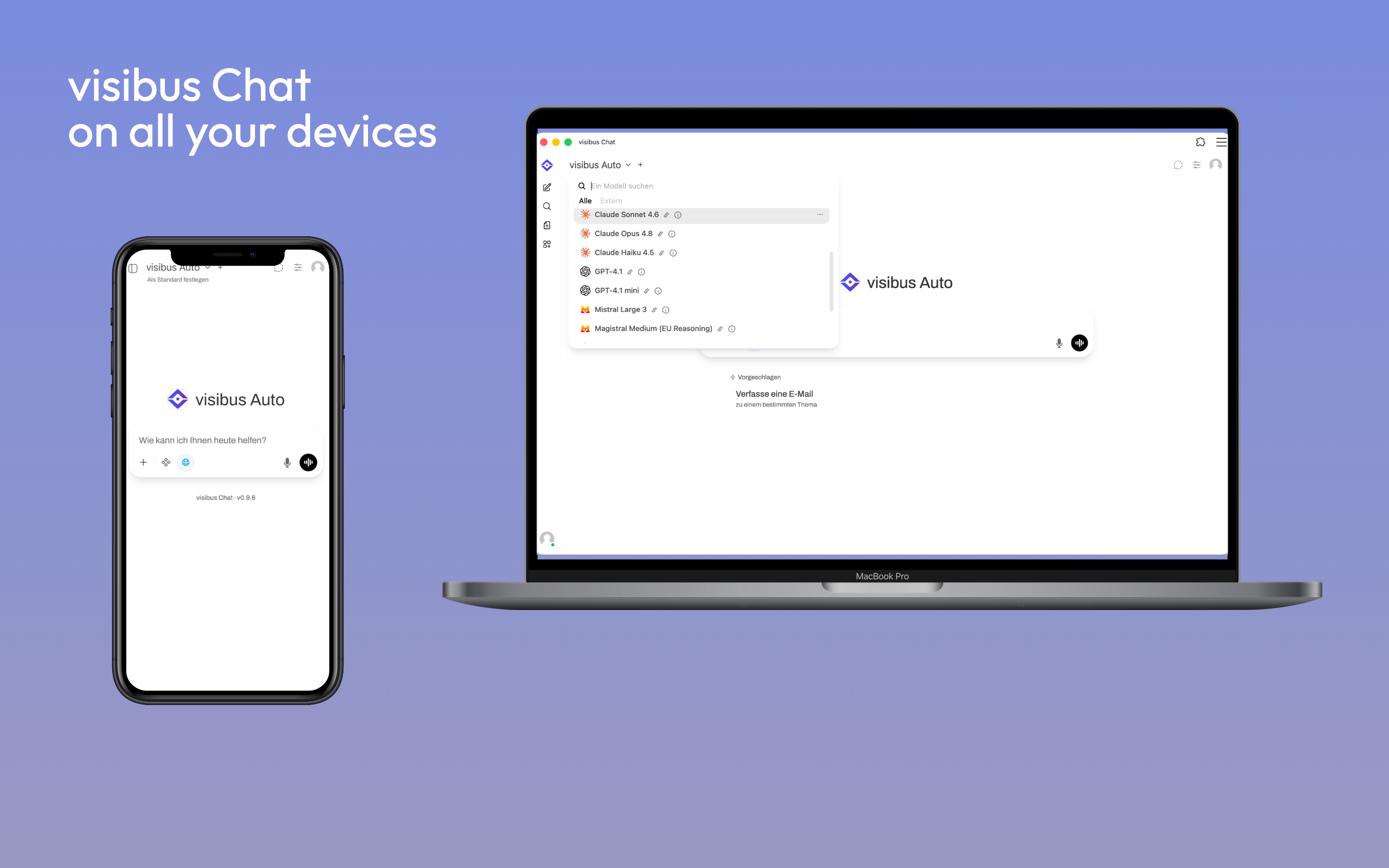
In visibus Chat, all models sit side by side, and you pick the right one for each task. And the Auto mode takes that choice off your hands: it routes every request to the fitting model - the small one for simple things, the big one for complex ones. You don't have to match them yourself, and you pay premium only where it truly pays off.
The bottom line
The cheapest number isn't automatically the best. A flat rate that an investor subsidizes and that you pay for half-empty seats is no basis for planning - it's a bet that nothing will change. Usage-based billing shows you what AI really costs in your company today, and what it will cost when prices normalize.
Curious what that calculation looks like for your company? Get in touch - we'll go through it together.