
visibus Blog
Clarity first, then digitalization
by Lubomira Schmid · October 28, 2026 · 8 min read
The new software is in place. The switchover took months, the training sessions are done, everything looks more modern. And the problems that started the whole project are still there.
Sometimes things have even gotten worse. People have more work than before, because the old way simply keeps running and the new one has been added on top.
And yet digitalization promises exactly the opposite. Less administrative work, clearer processes, finally more time for the tasks that really matter. Especially in small and mid-sized companies, where many people carry several jobs at once, that sounds like real relief.
I have seen this play out more than once. So why does it happen?
Often because we focus on the solution too early and too little on the actual problem.
New software doesn't turn a bad process into a good one
Taking on responsibility in a number of different companies has taught me one thing above all: how differently organizations can work.
Some processes are brilliantly thought through, others have grown over the years and are hardly ever questioned anymore. Not because nobody cares, but because day-to-day business simply leaves no time for it.
There's an Excel list that gets maintained even though the same information already lives in another system. Invoices pass through several hands because at some point someone decided that's how it has to be. And important information sits in personal folders, even though several people actually need access to it.
As long as everything works somehow, none of this really stands out.
And then someone is out
Then come vacations, an illness or a resignation. And suddenly what's missing isn't just a pair of hands, it's a process. It was never written down anywhere, it lived in one person's head.
New employees then need months to get up to speed, because there is nothing to read, only people to ask. And whoever knows the most becomes the bottleneck: every other question lands on the same desk, often the CEO's.
A company that runs on what's in people's heads grows exactly as far as those heads can keep up. Growth rarely fails because of the market. More often, it fails because the organization didn't grow along with it.
And this is exactly where the real work begins for me. Not with the question of which software we should buy, but with understanding together why things work the way they do today.
Because if you digitalize unclear processes, at worst you just make the chaos faster.
Sometimes a good conversation comes before new software
When I talk with business owners about their processes, there's one question I find especially revealing: Why do you actually do it this way?
The answers are often strikingly similar.
"We've always done it this way."
"A former employee of ours set that up back then."
Or my personal favorite: "To be honest, I don't remember anymore."
And you know what? That's completely normal.
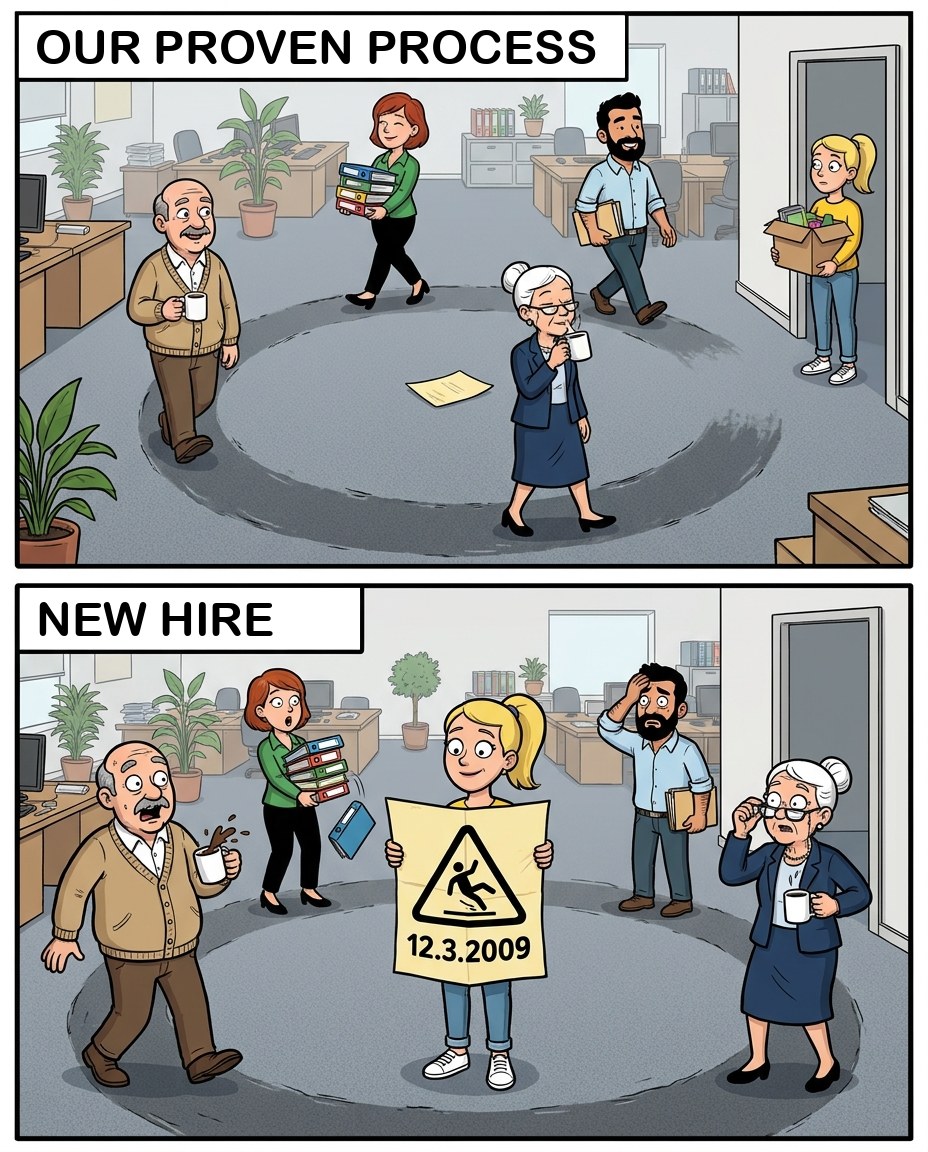
Small and mid-sized companies in particular have often grown over many years. New employees join, tasks get handed out, responsibilities shift, and at some point you end up with an organization that works, but isn't necessarily as efficient as it could be.
That's why optimizing processes isn't about questioning everything that exists or telling people they've been doing something wrong.
Quite the opposite. Often the people who work with these processes every day know the weak spots best. You just have to listen to them and figure out together what can be simplified.
Sometimes that leads to a bigger change. But sometimes it's enough to cut two unnecessary steps, clearly define a responsibility or store information in one central place.
Not particularly spectacular, I know. But often surprisingly effective.
Three questions you can answer this afternoon
You don't need a consultant for this. Pick a process that regularly gets on your nerves and ask three questions.
Who is responsible, and who closes it out? Not who works on it, but who decides that the job is done. If the people in the room give different answers, you've found your starting point.
Where does the knowledge live? In one person's head, in an email thread, in a folder only two people know about? Anything that exists only in someone's head is both a bottleneck and a risk.
Where do follow-up questions and duplicate work come up? Wherever the same question gets asked again every month, what's missing isn't software, it's a decision.
Not everything that can be digitalized should be
I'm a strong advocate of technology used well. I use digital tools and artificial intelligence every day myself, and there are many of these capabilities I wouldn't want to give up.
Still, I'm convinced that with digitalization we sometimes look a bit too much at what's technically possible and too little at the actual benefit.
Just because a process can be automated doesn't mean it makes economic sense. If a task takes only a few minutes a month, you really have to ask whether an elaborate automation is worth it.
And if a process is unnecessarily complicated, you should simplify it first before trying to speed it up with technology.
For me, the key is not to digitalize as much as possible, but to start where companies and their people will actually feel the relief.
And then there's artificial intelligence on top of it all
As if digitalization weren't demanding enough already, artificial intelligence now opens up possibilities that were hard to imagine just a few years ago: analyzing documents, drafting texts, preparing information, supporting recurring tasks. Much of this works remarkably well today.
But the same principle applies here too: first we need to understand what we want to improve.
AI can support employees, make information accessible faster and simplify processes. What it can't do is make sure responsibilities are clear. If nobody knows where the current information lives, which data is authoritative or who is responsible for a decision, artificial intelligence won't answer those questions either.
On top of that comes responsibility for your own data. When employees use various freely available AI tools without clear rules in place, new challenges arise. Why a company-owned access is the better way here is something we've covered in a separate post.
Digitalization isn't just an IT matter
One point is especially close to my heart: digitalization doesn't simply belong in the IT department.
Of course you need experts who know the technical possibilities. It doesn't work without them, and that's a good thing. But the question of how a company works, which processes make sense and where change becomes necessary is first and foremost an organizational and business task.
I don't come from IT myself, even though throughout my career I've repeatedly been responsible for this area, always with the right experts at my side. That's exactly why I know how important collaboration between management, employees and technical specialists is.
Technology has to fit the organization, not the other way around.
And above all, we must not forget one thing: behind every process there are people. People who want to do their work well, who get frustrated by unnecessary administrative tasks and who are glad when something finally works more simply.
Why we talk about structures first at visibus
It's exactly this conviction that shapes our approach at visibus. It may sound less spectacular than the next big technology announcement, but for us it's essential: we want to create clarity first, before we get going with digitalization, automation or artificial intelligence.
That's why we're deliberately adding another focus to what we offer: supporting small and mid-sized companies with processes and organization. In practice, that means:
- analyzing and simplifying existing processes,
- clarifying responsibilities and handoffs,
- developing structures that have grown over time in a sensible direction,
- making administrative processes more efficient,
- identifying the right opportunities for digitalization and AI.
This isn't about completely reorganizing every company. Often it's small adjustments that already have a big impact.
With visibus Chat, we've also built a solution that lets companies use different AI models centrally and in a controlled way. Our goal is to give SMEs in particular simple and responsible access to artificial intelligence.
But even with our own solution, we never lose sight of one thing: technology should serve people, not create additional complexity. Because in the end, management doesn't care much how impressive a technology is behind the scenes if it doesn't bring any noticeable benefit to everyday work.
My conclusion: sometimes less technology is the better start
I believe digitalization and artificial intelligence offer SMEs enormous opportunities. Many tasks can be done more easily today, information can be processed faster and employees can be relieved where it matters.
But I believe just as strongly that we should sometimes take a bit more time before introducing the next piece of software. Time to listen, ask questions and challenge existing processes.
Because not every problem needs a technical solution. Sometimes what's needed first is a clear decision, a simpler structure or a shared understanding of how we want to work together going forward. And once those foundations are right, technology can show its real strength.
That's why, for me, successful digitalization doesn't start with software, it starts with clarity. And sometimes that is exactly the most important progress.
Where in your company are there still unnecessary detours, duplicate work or recurring follow-up questions today? If you'd like to look at that together, get in touch.